
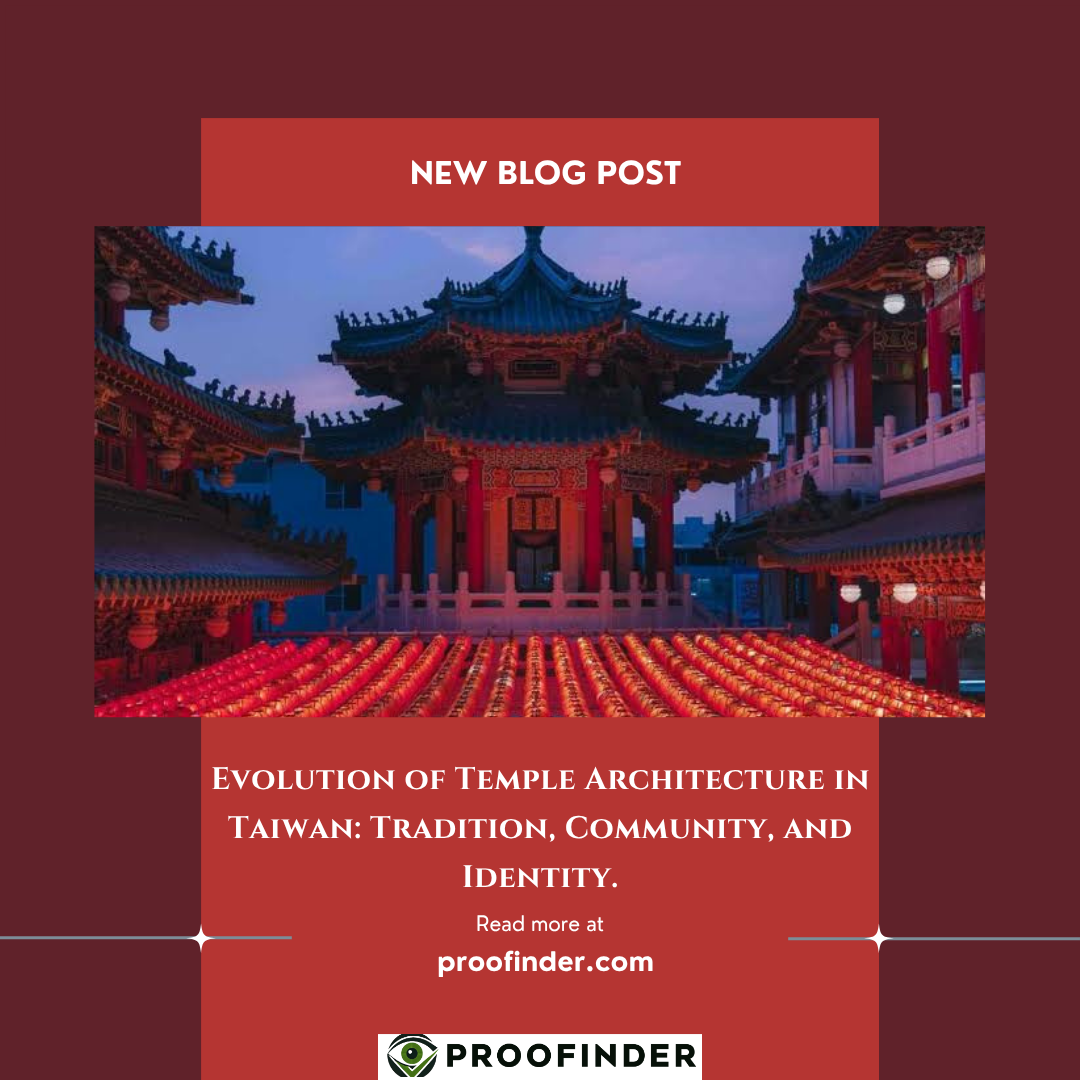
Evolution of Temple Architecture in Taiwan: Tradition, Community, and Identity
Taiwan’s first Han-Chinese temples were built by immigrants from southern Fujian as far back as the early Qing era. For example, Taipei’s Longshan Temple (est. 1738) was founded by migrants from Jinjiang (Fujian) to house a Guanyin statue from their homeland. These temples followed the standard siheyuan courtyard layout (a three-hall, five-bay plan) brought from Fujianese tradition. Likewise, Lukang’s Tianhou Temple (Lukang Mazu Temple) dates to the late Ming/early Qing period, initially housing a sea goddess statue that a Min-nan master brought over in 1725.
Over the centuries in Taiwan, temples were repeatedly enlarged and rebuilt by local communities, using local materials and talents. In many cases new generations of Taiwanese craftsmen fused traditional Fujianese forms with local innovations. At Longshan, for instance, a 1920s restoration led by master carpenter Ong Ek-sun (from Quanzhou) and others created an “architecture showcase” of folk art. The renovated Longshan Temple acquired a palatial front hall with an octagonal wooden zaojing ceiling and Taiwan’s only pair of bronze dragon columns. Even its bell-and-drum towers, built atop the side wings, featured triple-eaved hexagonal roofs – the first such design in Taiwan. As the Ministry of the Interior notes, the result was a “hall of living [folk] art” where “the entire structure is a repository of exquisite… woodcarvings, paintings, and tracery”. By contrast, a Fujian temple of the same era would have had simpler single-eaved roofs and fewer native touches.
Thus by the early 20th century, a “Taiwanese style” had emerged: it retained southern Fujian motifs (e.g. dougong bracketed eaves, grand courtyards) but layered on local elaborations. Longshan’s famous caisson ceilings – an octagonal one in the front hall and a round one in the main hall – were “masterpieces” by carpenters well into the 20th century. Lukang’s 1936 renovation (the one still seen today) similarly produced a richly decorated temple with elaborate wood and stone carvings deemed “some of the most delicate works in Taiwan”. As one temple guide observes, these temples’ “opulent architecture, archaic carvings, and painting by master artisans” earned them nicknames like “Palace Hall of Arts”.
Example: Longshan Temple (Taipei, est. 1738). Longshan Temple began as a Fujian-style shrine to Guanyin; its history mirrors Taiwan’s evolution. Founded by migrants from Jinjiang, it was rebuilt multiple times after disasters. The 1920 restoration by artisans Ong Ek-sun and others gave it the look seen today: a sprawling three-hall complex with ornate dougong eaves, exquisitely carved pillars, and two spectacular caisson ceilings. Its side towers bear Taiwan’s first sedan-chair (jiǎodǐng) triple-eaved roofs. In short, Longshan blends traditional Fujianese layout with Taiwanese exuberance – making it a “living museum” of temple art and an architectural testimonial to Taiwan’s sinicized heritage.
Master Craftsmen: Woodcarvings and Cut-and-Paste Art
A key way Taiwanese temples express identity is through craftsmanship. Two elements stand out: elaborately carved wooden structures and the jiǎnnián technique of inlaid ceramic figurines. In Taiwan, these crafts have been sustained by generations of master carpenters and artisans. The result is a visual language of columns, beams, and roof ridges that is recognizable as Taiwanese.
Woodcarving. Temple frames in Taiwan use local woodcarving traditions that evolved from Fujian origins. Lukang, Changhua is famous for its woodcarvers. As the Lukang township tourism office notes, local carvers produce lively deity statues, altars and palanquins “based on traditional mortise woodcraft,” with designs that still reflect Quanzhou (Fujian) motifs. In Temples like Lukang’s Tianhou, every beam and column is covered with such carving – dragons, phoenixes, floral arabesques, and scenes from folklore. These carvings are often done “without glue or nails,” using joinery techniques passed down in master workshops. Today the skills are safeguarded by a master-apprentice system: for example, Li Ping-kuei of Lukang (a “National Living Treasure” for woodcarving) has honed a unique style that “preserves the essence of traditional carving” while innovating details.
Lukang’s craftsmen are known for dynamic woodcarving—“verve and posture” in deity statues and complex painted crests drawn from Fujianese origin. In Lukang and elsewhere, these carved ensembles give the temple a uniquely Taiwanese character built on shared Minnan roots.
Jiǎnnián (Cut-and-Paste Ceramic Sculpture). Another hallmark is jiǎnnián, the mosaic-like decoration of roof ridges. Artisans cut and trim pieces of broken ceramic bowls and tiles, then paste them (with glutinous rice mortar) onto sculpted clay forms. The effect is 3D sculptures—dragons, phoenixes, deities, flowers—glittering with porcelain fragments. This technique is a direct continuation of Minnan craft (known in Fujian as giennian), but it has become especially associated with Taiwanese temples. For instance, Ang Khun-hok, one of Longshan Temple’s 1920 craftsmen, was a master of Koji ceramics and jiǎnnián. Today’s temple workshops still practice it: Lin Fu Chun, founder of Taiwan’s largest temple-building factory, “specialised in the craft of decorative surface detailing,” creating rooftop sculptures with ceramic shards—“dragons, deities, pagodas” and the like. Temple artisans universally use this vocabulary of colored shards (often featuring Min-nan family emblems) to imbue the rooflines with Taiwanese flair.
The combination of local woodcarving and jiǎnnián makes temple facades instantly identifiable. As one Taiwanese artisan noted, “temples that worship Guan Gong, Tudi Gong, Mazu” all share these motifs (dragons, tiger guardians, etc.), but with variations reflecting each community. In short, these crafts form an artistic substratum of Taiwanese temple design. They are also intangible heritage: Taiwan’s government recognizes master carvers as “National Living Treasures” precisely for keeping these skills alive.
Temples as Living Heritage: Community and Festivals
Beyond architecture and art, Taiwan’s temples thrive as community centers, ensuring the buildings remain “living” heritage. Nearly every township has a neighborhood temple that hosts weekly markets, educational events, opera performances, and charity drives. Critically, temples anchor major festivals: for example, the Beigang Chaotian Temple is the focal point of the annual Mazu Pilgrimage in Yunlin County. On Mazu’s birthday (3rd lunar month, day 23) the temple compound “is commonly filled with many worshippers” and thronged by processions. Likewise, Lukang’s Tianhou Temple holds parades for Mazu and Lantern Festival events that draw crowds from across Taiwan. These rituals are often UNESCO-recognized folk customs (e.g. Beigang and Dajia Mazu pilgrimages), underlining the link between temple architecture and living tradition.
The community role feeds back into the architecture. Temple committees continually fund maintenance, and local donors commission new artworks. Longshan Temple, for instance, served as an immigrant social hub under Qing rule, and even housed soldiers during post-war turbulence. Today its halls still function: inner wings once served as dormitories for Kuomintang soldiers, showing how the temple adapted to societal needs. In rural areas, temple elders fund apprenticeships in carving and painting, ensuring new generations learn the arts. The surrounding community also dictates temple style: the eclectic pantheon at Longshan (housing gods from Buddhism, Taoism, and folk belief) “reflect[s] Taiwan’s inclusive attitude” towards religion, as the temple curator notes.
Preservation Challenges in the Modern Era
While temples continue as cultural symbols, traditional craftsmanship faces challenges. The labor-intensive jiǎnnián and carving arts are declining. In 2004 Taiwan registered only 37 jiǎnnián artisans nationwide. By the late 2000s some warned it “may become a lost art due to government ignorance and… regulations” that favor low-cost contractors Temple renovations under tight budgets often hire cheaper, mass-produced decorations instead of hand crafted mosaic. A Ministry workshop forum noted that even when preserving temples, firms may replace real porcelain shards with pre-molded pieces to cut costs. As a result, the very roof statues that once lasted decades now “fall apart quite easily” if made by unskilled hands. Moreover, demographic shifts mean few young people choose these demanding crafts (Taipei’s jiǎnnián master Pan Kun-ti found only one apprentice).
The Taiwanese government and communities are responding. The Ministry of Culture’s “Living Treasures” program highlights masters like Li Ping-kuei (ornamental woodcarving) and Hung Ping-shun (temple painting) to encourage apprenticeship. Some temples fundraise privately to do authentic restorations: Dalongdong Baoan Temple (Taipei) spent seven years (2000 2007) on a historically faithful renovation, explicitly using original jiǎnnián techniques. Academic and cultural centers are also digitizing temple art (e.g. 3D scans of caisson ceilings) to preserve designs for posterity. Nonetheless, experts warn that without stronger support, “not many jiǎnnián masters” will remain by the time regulation reforms are enacted. In short, Taiwan is grappling with how to keep this “living heritage” alive amid modernization.
In sum, Taiwan’s temple architecture is a cultural palimpsest: each building layers immigrant origins, local craftsmanship, and community life. This is why, beyond mere physical structures, temples have become potent symbols of Taiwanese identity. They encapsulate migration history (through Fujianese styles), artistic ingenuity (through woodcarving and jiǎnnián), and ongoing social practice (through festivals and apprenticeships). Protecting them thus means safeguarding the very narrative of Taiwan.
"Preserving ancestral whispers through sacred roofs, Taiwan’s temples remain living sanctuaries where heritage shapes modern identity."