
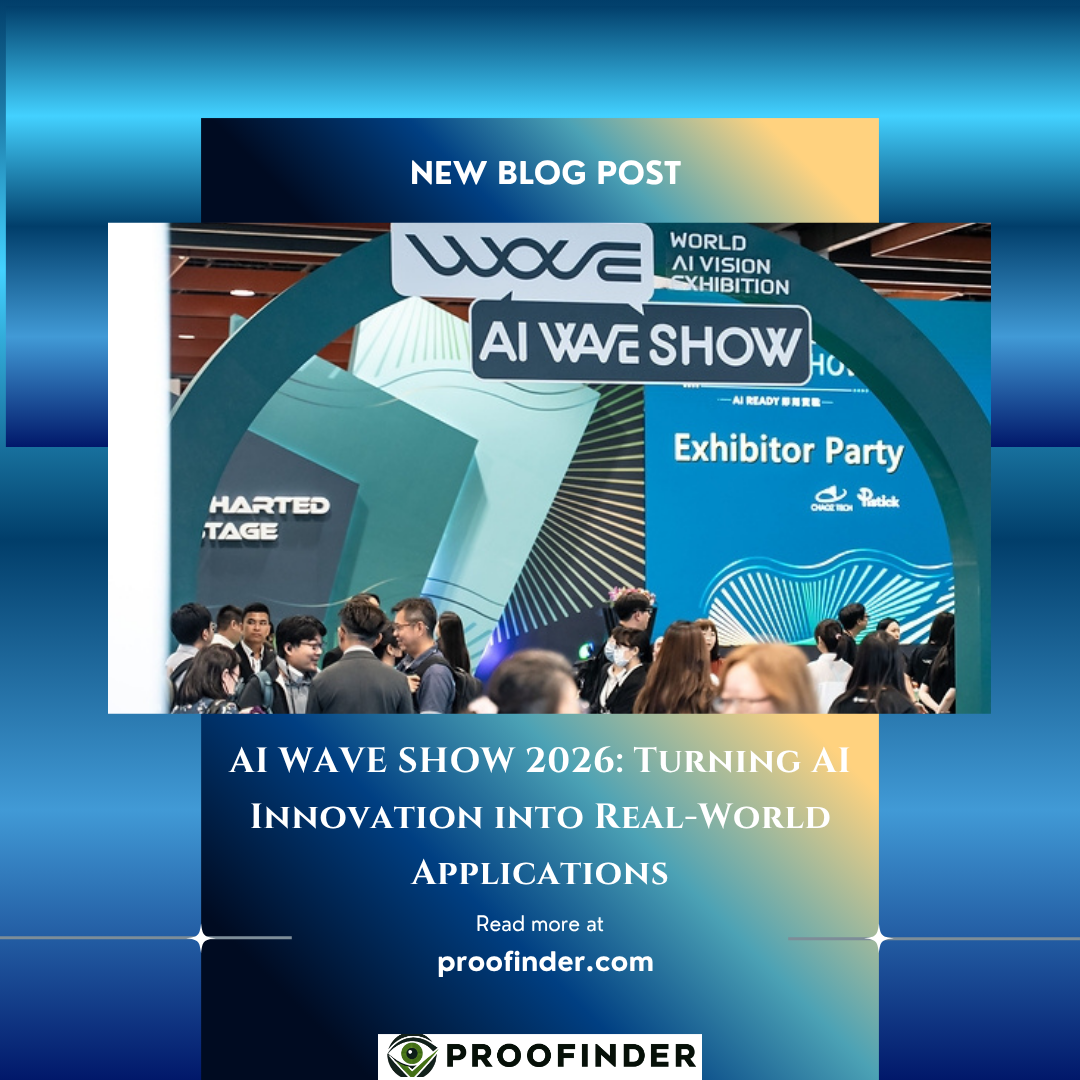
AI WAVE SHOW 2026: Turning AI Innovation into Real-World Applications
Held from July 30 to August 1 at Taipei World Trade Center Hall 1, AI WAVE SHOW 2026 brought together companies, startups, government representatives, technology professionals, and international participants under the theme “AI Ready.” More than 200 brands and enterprises showcased over 350 AI solutions, while the three-day event attracted more than 52,000 visitors and hosted 61 forums, networking activities, and business events.
Unlike exhibitions centered primarily on emerging AI models, AI WAVE SHOW 2026 placed considerable emphasis on the transition from technological experimentation to practical implementation and commercialization. Manufacturing, healthcare, retail, telecommunications, cybersecurity, enterprise services, and data management were among the major application areas represented throughout the event.
AI Agents, Edge AI and the Shift Toward Practical Deployment
One of the strongest themes of the exhibition was the development of AI Agents. The growing interest in agentic systems reflects an important change in the industry: AI is increasingly expected not only to generate information but also to perform tasks, coordinate workflows, interact with enterprise systems, and assist organizations with operational decision-making.
Edge AI represented another important part of this transition. By processing information closer to where data is generated, rather than depending entirely on remote cloud infrastructure, Edge AI can provide advantages in speed, privacy, connectivity, and data control. This is particularly important \ for industries such as manufacturing and healthcare, where real-time processing and sensitive information are major considerations.
The exhibition therefore highlighted several closely connected trends:AI Agents: Moving from responses to actions.
Edge AI: Bringing processing closer to users and devices.
Enterprise AI: Integrating AI into everyday operations.
Industry applications: Expanding deployment across manufacturing, healthcare, and retail.
Major technology and telecommunications companies also demonstrated how these technologies are being incorporated into existing business environments. The significance of these demonstrations was not simply the introduction of new AI products, but the growing emphasis on integrating AI into established organizational processes.
This represents a broader transformation in the AI industry. Companies are increasingly moving beyond the question of what artificial intelligence is capable of doing and focusing instead on where it can be deployed, what operational problems it can solve, and how it can generate measurable business value.
Taiwan’s Expanding Position in the Global AI Economy
AI WAVE SHOW 2026 also reflected Taiwan’s ambition to build on its established strengths in semiconductors, electronics manufacturing, computing infrastructure, and technology supply chains while developing greater capabilities in AI software, platforms, system integration, and commercial applications.
This transition is strategically important. Taiwan already occupies a central position in the hardware infrastructure supporting the global AI industry. Developing stronger capabilities in software and applications could allow Taiwanese companies to participate in a broader share of the value created by AI rather than remaining concentrated primarily in hardware and manufacturing.
The event emphasized several elements of this strategy:Commercialization: Connecting AI technologies with business demand.
International cooperation: Expanding overseas technology partnerships.
Government support: Strengthening computing, data, talent, funding, and market access.
Ecosystem development: Connecting hardware, software, and practical applications.
The commercial dimension was particularly visible through business-matching and networking activities. Organizers reported more than 3,000 business matches, demonstrating that the exhibition was intended not only to showcase technology but also to create partnerships and commercial opportunities.
International participation further reinforced this objective. Companies, startups, professional buyers, and technology organizations from overseas participated in the event, positioning AI WAVE SHOW as part of Taiwan’s effort to strengthen its connections with the wider regional and international AI ecosystem.
Government involvement also demonstrated the importance Taiwan places on creating the conditions necessary for private-sector AI development. Rather than treating AI solely as a technology industry, the event presented it as an ecosystem requiring computing resources, data, skilled personnel, investment, market access, and cooperation between technology providers and traditional industries.
Overall, AI WAVE SHOW 2026 demonstrated an AI industry moving from experimentation toward implementation. AI Agents, Edge AI, and enterprise applications showed how artificial intelligence is increasingly becoming integrated into real economic activity.
For Taiwan, the opportunity is particularly significant. Combining its existing semiconductor and hardware strengths with stronger software, AI services, and industry-specific applications could reinforce its position in the next stage of the global AI economy. In this sense, the central message of AI WAVE SHOW 2026 was clear: the next AI wave will be defined not only by increasingly powerful technology, but by how effectively that technology can be transformed into practical and commercially valuable applications.
"AI WAVE SHOW 2026 highlighted Taiwan’s evolution from an AI hardware powerhouse into a broader hub for intelligent applications and commercialization"