
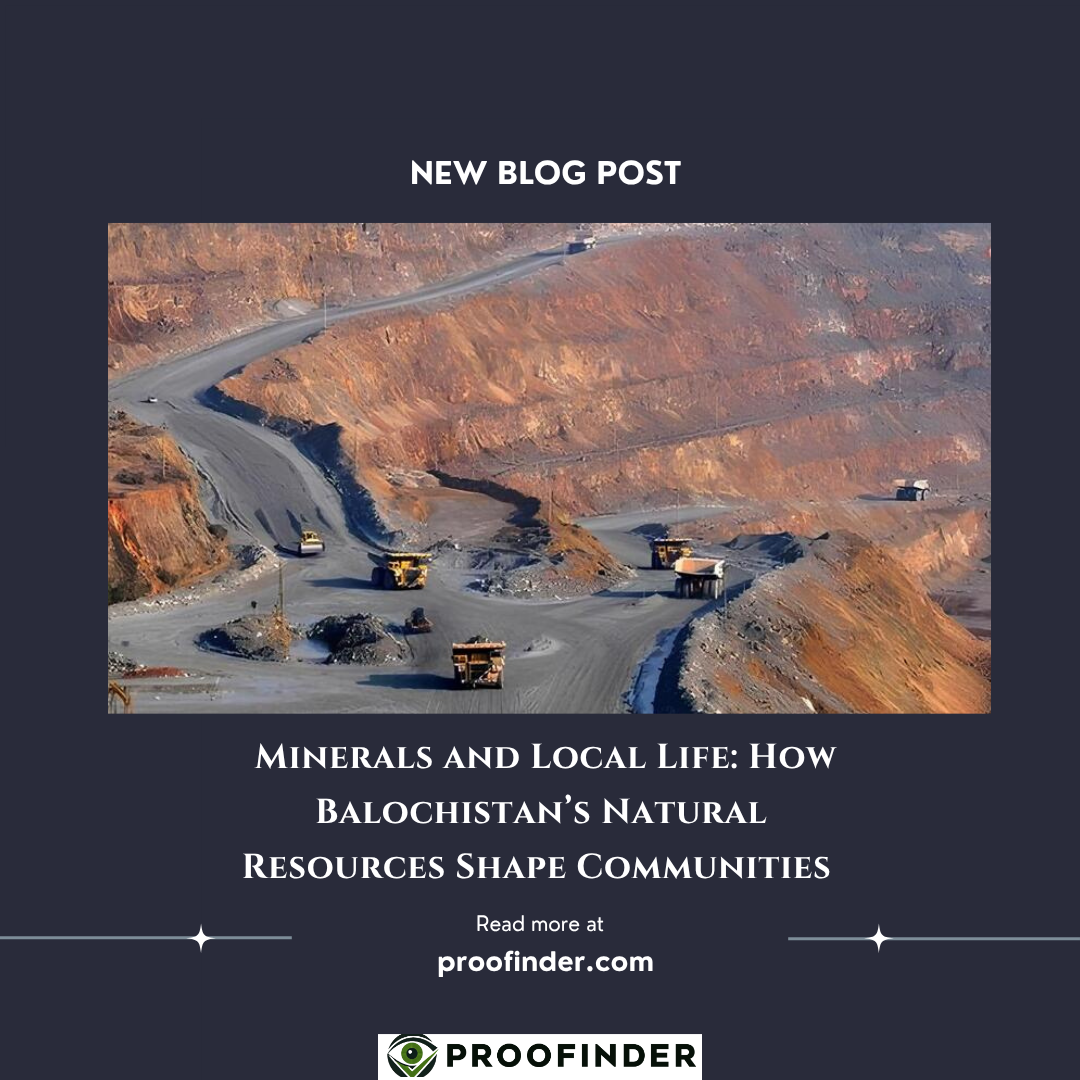
Minerals and Local Life: How Balochistan’s Natural Resources Shape Communities
Balochistan, Pakistan’s vast southwestern province, holds outsized mineral wealth – from copper, gold, chromite and coal to gas – yet local communities often see little benefit. Large-scale projects like Reko Diq (copper-gold) and Saindak (copper-gold) are led by foreign or state-run firms, generating investment and jobs but fueling disputes over who reaps the rewards. While mines provide some local employment and infrastructure (roads, water), much of the revenue flows to the federal treasury or foreign investors. Environmental stresses, militant attacks, and human rights concerns complicate the relationship between extractive projects and local livelihoods.
Resource Wealth and Geology
Balochistan is extraordinarily rich in minerals. Government surveys and academic sources note vast deposits of copper, gold, coal, chromite, marble, and gasFor example, the Chagai district hosts roughly 650 metric tons of gold and over 12 million tons of copper (undeveloped). The province also holds about 19.3 trillion cubic feet of natural gas (a large share of Pakistan’s proven gas) and untapped oil fields. Confirmed coal reserves (e.g. Chamalang) are estimated in the hundreds of millions of tons. In short, Balochistan supplies a major share of Pakistan’s known mineral wealth.
Major Mines and Investment
Most large mining projects in Balochistan involve state and foreign partnerships. The Reko Diq copper-gold project (Chagai District) is owned by a joint venture (50% Barrick Gold, 25% federal Pakistani entities, 25% Balochistan government). It has attracted billions in finance – e.g. a $700 million IFC/World Bank loan – and is slated for phased production (tens of thousands of tons of ore per year). Saindak (Chagai) is another copper-gold mine, operated by China’s MCC under a lease; profits are split (~53% to Pakistan, ~6% to Balochistan). Likewise, Balochistan’s Chamalang coalfields (Loralai/Kohlu) are run by national companies with army-facilitated contracts; they have produced millions of tons of coal since 2007. Overall, foreign investment (Chinese and multilateral lenders) and federal provincial JVs dominate big projects, while smaller deposits (marble, chromite, gemstones) are exploited by local firms or artisanal miners.
Economic Benefits and Livelihoods
Mining projects bring jobs and some infrastructure, but local communities often see uneven gains. Chamalang coal has employed tens of thousands (est. 55,000 jobs, including levies and laborers) and generated billions in revenue. Saindak’s MCC lease reportedly created over 2,000 jobs and funded a local hospital. Reko Diq is projected to employ thousands (Barrick reports ~77% of staff from Balochistan). However, many skilled positions go to outsiders, and locals often work in low-skill roles. Supply chains (trucking, services) create some business, but skills shortages limit local employment uptake.
Revenue sharing is another flashpoint. Provincial royalties and profit shares are small (e.g. Saindak’s 5–6% for Balochistan), while most profits go to Islamabad or foreign firms. Analysts note a “resource curse” pattern: despite mineral wealth, Balochistan remains poor and underdeveloped. Remittances from migrants and federal transfers often exceed local resource revenues, and elite capture means that benefits rarely reach remote villages. In short, mining contributes to the economy, but much value “leaks” out of the province.
Environmental and Social Impacts
Large-scale mining strains scarce resources and disrupts communities. Balochistan’s deserts mean water is precious: Reko Diq and other mines could exacerbate shortages. Pollution from coal and metal extraction (dust, runoff) threatens farmland and health. Locals near Saindak report continued poverty and poor services despite long-term mining. The China-run mine funded some schools and wells, but activists say many villages still lack roads, potable water, and even electricity. Agricultural and pastoral livelihoods can suffer if grazing land is taken or water tables drop.
Socially, projects have spurred tension. The heavily militarized mine sites – checkpoints and patrols – isolate villages. Civil society groups call projects like Reko Diq “all but unsustainable”, warning of social harm and repression. In some cases, mine security forces are accused of labor abuses. Overall, extraction has brought some social programs (health clinics at Saindak, water schemes), but underdevelopment and grievances persist.
Infrastructure and Connectivity
Mining investments have spurred some infrastructure (roads, power) in western Balochistan. For instance, Pakistan’s army helped build roads into Chamalang coalfields. Gwadar Port and the Makran Coastal Highway, part of CPEC, improve regional transport, potentially easing export of minerals. However, analysis finds Balochistan has captured few local benefits from these projects. Skills gaps mean most construction and technical jobs go to outsiders. Energy pipelines (gas and oil) traverse Balochistan, but locals see little of the revenue. In summary, infrastructure for mining often bypasses communities rather than integrating them into new supply chains.
Governance, Security, and Conflict
Control over minerals is highly contested. Baloch nationalist groups long demand control and a fair share of resource income. Federal authorities have generally pushed development forward, often with heavy security presence. Balochistan has witnessed repeated militant attacks on roads and train lines, targeting state projects and infrastructure. In turn, mines like Reko Diq are protected by Pakistani paramilitary levies and private guards. Notably, Barrick paused Reko Diq work in 2026 due to security risks. Human rights monitors report crackdowns on activists opposing extraction (e.g. leaders of the Baloch Yakjehti Committee were arrested). The cycle of insurgency, counterinsurgency, and corporate caution means governance is complex: state, military, and corporations often set terms with little local input.
Community Responses and Adaptation
Communities have variously protested, petitioned, or sought partnerships. Grassroots groups (e.g. Baloch Yakjehti) have lobbied for local resource rights and benefit-sharing. Some locals form small businesses supplying mine camps or trucking materials. Mine companies do conduct limited Corporate Social Responsibility: Reko Diq’s developers note investments in schools, wells and training, and Saindak’s managers funded medical facilities. There are also calls for artisanal and SME engagement in mining. In some cases, tribal agreements (like the 2006 Chamalang peace deal) have been used to share jobs or royalties with tribes. Overall, however, adaptation is muted by insecurity and governance gaps. Many Baloch keep traditional livelihoods (herding, farming) alongside mine work. The picture is one of cautious benefit: communities seek more direct development (education, health, jobs) from the mineral bonanza but often organize protests when they feel bypassed.
"What lies beneath can shape life above"